
Before placement season
Students establish a practice habit early: realistic spoken interviews for the role families your campus actually places into, with feedback that names each student's specific weak areas.
 For organizations
Give students repeated practice for the roles and opportunities they're targeting, help them understand where their answers need work, and focus placement-team support where it matters most.
Structured practice. Readiness you can see. Never a ranking.

Before the real interview
Students explain decisions, handle follow-ups and work through coding problems in the interview itself. Feedback gives the next practice attempt a specific focus.
Practice rounds help students progress without rejecting them. Your team sets the retry limit and sees where support is needed.
Explore campus drive preparation →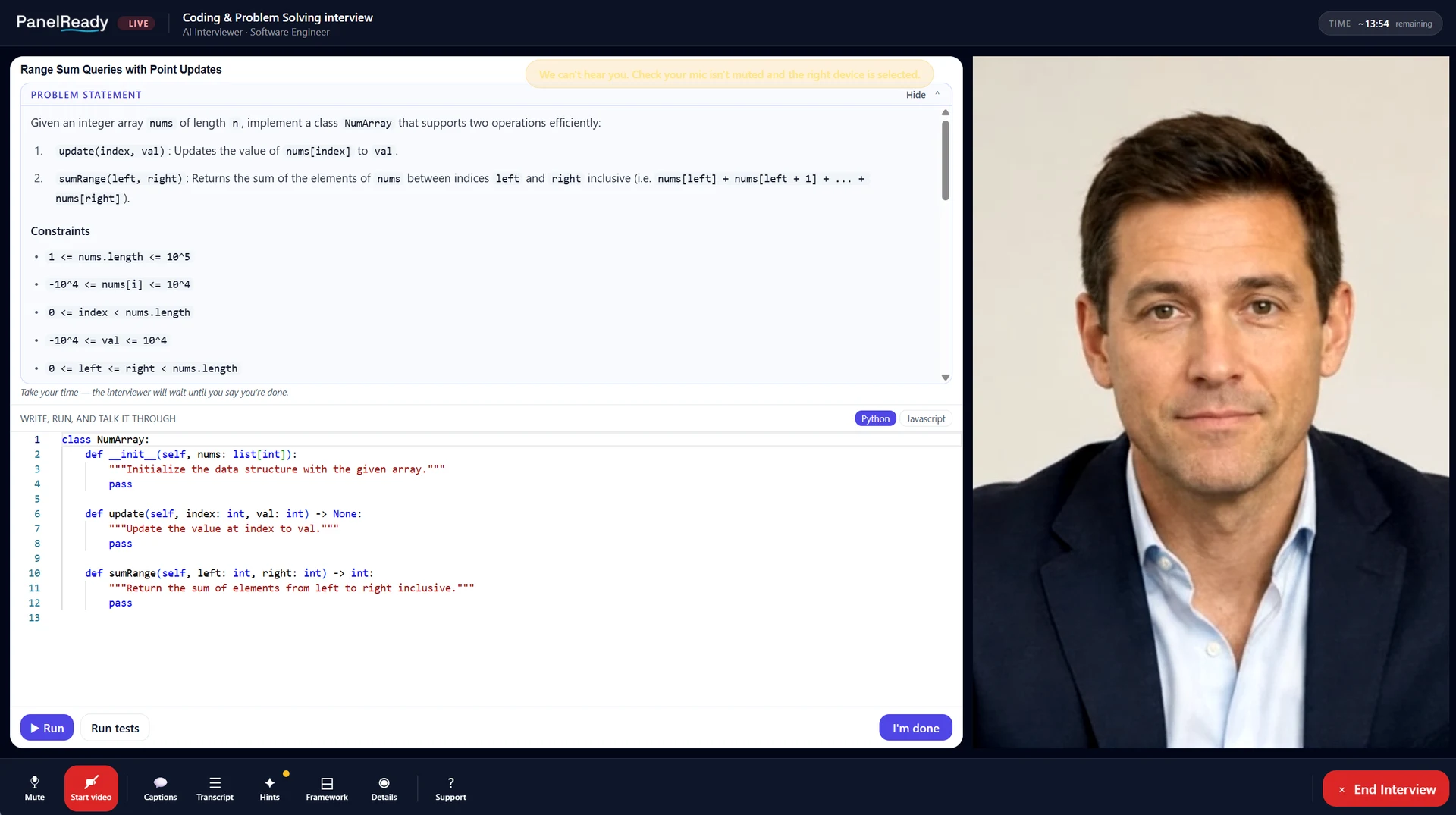
The readiness gap
A placement team preparing hundreds of students for a dated season can teach, schedule, and coach — but it cannot personally sit through the thousands of practice interviews a genuinely ready cohort represents.
The season has a deadline
Employer visits arrive on a date. Readiness has to be built before it, not discovered during it.
One workshop isn't repetition
A placement workshop can teach interview skills. It can't give every student enough interview repetitions.
One mock isn't readiness
Placement readiness is difficult to build in one mock interview — it's built in laps.
Practice concentrates in the wrong students
Confident students book the mock slots. The students who most need reps quietly avoid them.
Across the season
Students establish a practice habit early: realistic spoken interviews for the role families your campus actually places into, with feedback that names each student's specific weak areas.
Students practice for the roles in front of them — and can paste a specific job description to rehearse that exact opportunity, not a generic version of it.
One more realistic rep, on demand, the night before it counts — no mentor slot required.
Your team sees participation, completion, readiness signals by dimension, and the improvement areas that repeat across the batch — so intervention lands where it's needed.
Where it sits
Workshop → practice → feedback → retry → intervention → interview
Your team teaches interview skills, as it does today.
Students practice realistic spoken interviews independently, in the browser.
Each session ends with specific, scored feedback — what held up, what was missing.
Students re-run their weak areas until the improvement is visible.
Your team coaches the students and skills the cohort data says need human attention.
Students walk into the real interview having already survived the follow-ups.
Students judge the practice quality themselves before your team commits: see a full sample feedback report. This is readiness support, not student ranking — nothing in the placement offering rejects or filters anyone.
Placement-team FAQ
Broader learner-development program rather than a placement season? Explore PanelReady for Education →
Yes. Students can tailor a practice interview to a specific company at setup, or paste a job description to rehearse that exact opportunity. Twelve role tracks are covered — from software engineering and data roles to sales, marketing, and business analysis — each scored against level-calibrated rubrics.
The cohort dashboard shows participation, completion, readiness signals by scored dimension, and the improvement areas that recur across the batch. Your institution controls how scored feedback is released to students. This is readiness visibility for support and intervention — not student ranking.
A browser and a microphone. Students join through an email invite or a join link, sign in through your institution's branded page, and can practice immediately — no installs, no scheduling.
We scope the plan and practice allowance to your cohort and program. Start with a pilot discussion to confirm seats, usage and pricing before committing.
No — it sits between your training and the employer interview. Workshops teach the skills; PanelReady provides the repetitions and the diagnosis; your team spends its time on the students who need human coaching most.
Start a pilot
Institution, cohort size, and when your placement period runs — that's enough for us to come back with a concrete pilot shape for the season.
For placement cells, campus placement teams, and employability programs.
Pick one department or batch, run it alongside your existing placement training, and judge it on participation, repeat practice, and what students say. The Teams plan starts at 20 seats and is priced to your program.
What a pilot answers for you