More practice for every learner. More focus for every coach.
PanelReady gives learners realistic, role-specific AI interview practice with adaptive follow-ups, actionable feedback, and repeated opportunities to improve — while giving program teams visibility into participation and recurring skill gaps.
Realistic practice. Actionable feedback. Never a ranking.
AI-generated editorial illustration
This week: 23 of 40 learners practiced · 9 practiced twiceIllustrative
Two connected experiences
Learners practice and improve. Program teams see where support is needed.
For learners
Practice. Get feedback. Improve. Repeat.
A realistic spoken interview for the role they're targeting, an adaptive follow-up on what they actually said, feedback that names what was missing, and another attempt whenever they're ready.
Practice→
Feedback→
Focus→
Retry
For program teams
See participation. Identify recurring gaps. Focus support.
Who is practicing and coming back, which interview dimensions the cohort finds hardest, and the improvement areas that repeat — so workshops and coaching hours go where they help most.
Participation→
Skill patterns→
Support needs→
Targeted coaching
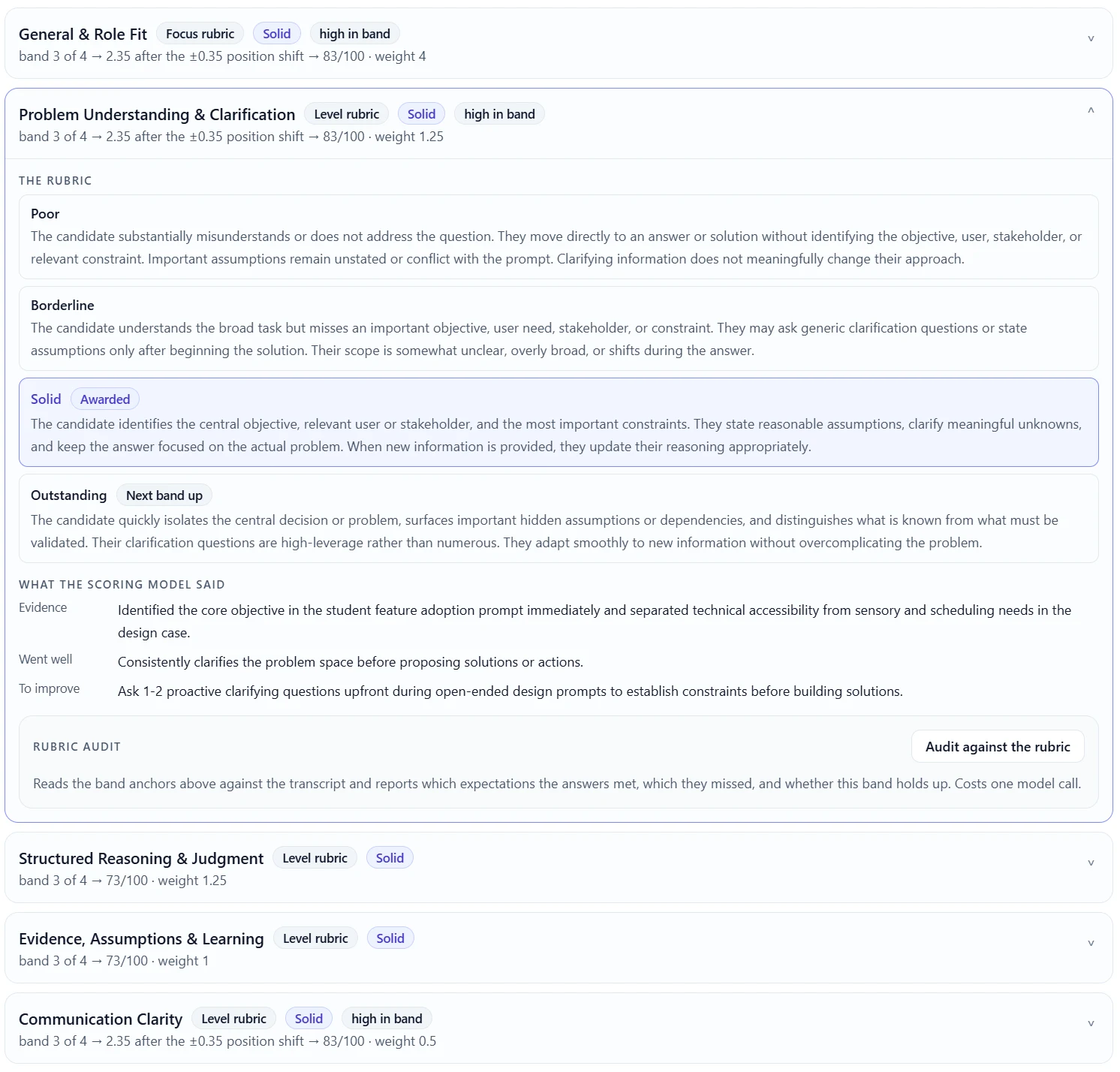
The evidence behind the score
Feedback that gives the next attempt a direction.
A learner should know what to try differently. Each rubric connects the awarded band to specific evidence, what went well and what needs work.
Actual product screen · Example dataOpen image to explore ↗
Beyond the question bank
Knowing the question is not the same as practicing the answer.
Most programs already provide workshops, interview questions, frameworks, or career guidance. The harder thing to scale is repeated spoken practice: answer the question, face a follow-up, understand what was missing, and try again.
Traditional preparation
Workshop
Question bank / framework
Occasional mock interview
Wait for another coaching slot
Repetition depends on coach availability, so most learners rehearse an interview once — or not at all.
With PanelReady
Learn
Practice out loud
Adaptive follow-up
Specific feedback
Improve · practice again
Human coach steps in where needed
Practice volume stops depending on calendar slots, and coaching time concentrates where it changes outcomes.
PanelReady does not replace your curriculum. It adds the repetition layer between learning and performance.
The learner experience
Practice that behaves more like an interview than a worksheet.
Learners join from a browser with a mic — email invite or join link, your organization's branded sign-in — and practice in voice, chat, recorded, or video format.
Practice→
Feedback→
Focus→
Retry↺
Role-specific practice
Learners practice interviews aligned to their target role or a specific job description.
Adaptive follow-ups
PanelReady responds to what the learner actually said instead of simply moving through a static question list.
Level-aware feedback
Feedback reflects the learner's target role and experience level, so an early-career learner isn't graded against a senior bar.
Specific feedback
Learners see what was missing or unclear in an answer — the unowned decision, the unmeasured result — rather than only a generic score.
Repeat practice
Feedback leads naturally into another attempt, so improvement happens through repetition — any time, no scheduling.
Judge the feedback quality yourself before any conversation:
See where support is needed — without watching every interview.
Participation & completion
Understand who is practicing and whether learners are returning for additional practice.
Practice progress
See patterns across interview dimensions without treating the data as a hiring prediction.
Common improvement areas
Identify recurring gaps across a cohort so workshops and coaching can address the areas that appear most often.
Program configuration
Organization-specific roles, rubrics, branding, cohorts, and control over how feedback is released to learners.
Learning visibility, not candidate ranking. PanelReady Education does not rank, filter, or reject learners.
Program dashboard · Spring cohortIllustrative sample
Participation this week
41/48
learners practiced at least once · 19 practiced again
Most common improvement areas
1Quantifying impact
2Handling follow-ups
3Concise openings
→ where a workshop or coaching hour goes furthest
Practice progress by dimension
Structure
72
Impact
48
Communication
66
Follow-up handling
54
Inside your program
A workflow your program already recognizes.
PanelReady fits into your existing career-readiness or employability program. Nothing is replaced — practice and measurement are added between the parts you already run.
Your existing workshops, curriculum, faculty, or coaches introduce interview skills and frameworks.
Step 2 of 602
Practice
Learners complete realistic interviews independently — by email invite or join link, in the browser, whenever they're ready.
Step 3 of 603
Diagnose
Feedback identifies specific gaps in the learner's answers.
Step 4 of 604
Improve
Learners apply the feedback in another attempt.
Step 5 of 605
Coach
Human support focuses on learners and skills requiring deeper intervention.
Step 6 of 606
Measure
Program teams review participation and recurring skill trends in the program dashboard.
Who it's for
Built for the teams responsible for learner development.
The problems are related but not identical — here's how each kind of program tends to use PanelReady.
Colleges & universities
Extend career services, employability programs, internship preparation, and classroom-based career development with realistic interview practice learners can access throughout the year.
Add realistic interview practice to role-based training so learners can repeatedly practice explaining and applying what they have learned before entering real interviews.
Career centers
Give students and alumni practice between appointments, while helping advisors see recurring areas where additional support may be useful.
Workforce & employability programs
Provide job seekers and career-transition participants with private, repeatable interview practice as part of a broader employment-support program.
Role-specific cohort preparation
Point any cohort at one role and level — with your own rubrics if you have them — and rehearse the kind of interview that is coming.
Start with one cohort and expand across programs, departments, campuses, or learner populations. Organization plans are priced per program.
Responsible use
Built for learner development — not candidate screening.
PanelReady is for preparation before a real interview. It is not a live-interview copilot, and we don't build one.
Consent before recording
Nothing is recorded until the learner has explicitly agreed.
Retention and deletion controls
Interview audio auto-purges after the retention window; your organization sets its retention policy, and learners can export or delete their data.
No model training on learner content
Learner interviews and feedback are not used to train foundation models.
Organization audit logs
Administrative actions in your organization are recorded and reviewable.
Practice and improvement, not ranking
PanelReady Education does not rank, filter, or reject learners.
Not on this offering. PanelReady for Education is interview readiness and practice infrastructure for learners — it exists to help people improve before evaluation, with no ranking, filtering, or rejection anywhere in the learner experience. (PanelReady does offer a separate product for employer-run first-round interviews; see PanelReady for Hiring.)
How does the AI evaluate answers?
Against behaviorally anchored rubrics for the role and target level the learner picked. Each dimension score quotes evidence from what the learner actually said, and every session ends with specific fixes. Scores are practice guidance, not a prediction of any employer's decision — and learner content is not used to train foundation models.
Will learners actually use it?
That's exactly what a pilot measures, so we'd rather show you than promise it. The product is built to be voluntarily used — practice feels like a real spoken interview, feedback names something concrete to fix, and the next attempt is one click away. A pilot shows you participation, completion, and repeat-practice numbers for your own cohort.
How is PanelReady priced for organizations?
Organization plans (the Teams plan) are priced per program. Start with one cohort and expand across programs, departments, campuses, or larger learner populations — every seat gets unlimited practice interviews. Contact us and we'll scope it to your program.
What does my team see, and what stays private to the learner?
The program dashboard shows participation, practice progress by dimension, and common improvement areas across the cohort — learning visibility, never a ranking of learners. Your organization controls how feedback is released to learners. Consent is captured before any recording, and interview audio auto-purges after the retention window.
Does this replace our career coaches or mentors?
No, and it isn't meant to. PanelReady covers the repetition — realistic, scored practice on demand — so your coaches can spend their limited hours on narrative shaping, presence, and the learners who most need human attention.
What do learners need to get started?
A browser and a microphone. Learners join through an email invite or a join link, sign in via your organization's branded page, and can start a practice interview immediately — no installs or scheduling.
Can we use our own roles and rubrics?
Yes. The Teams plan supports organization-specific roles, rubrics, and branding on top of the standard catalog of twelve roles with level-calibrated rubrics.
Will PanelReady help learners during real interviews?
Never. PanelReady is practice only — we deliberately don't build live-interview copilot features, which means programs can stand behind it without integrity concerns.
Pilot it. Measure what actually happens. Expand if it earns a place.
Start with one learner cohort.
Use a focused cohort to understand whether learners practice voluntarily, engage with the feedback, return for additional attempts, and whether the resulting insights help your team focus its coaching and program support.
What the pilot measures
Activation
Interviews started and completed
Feedback viewed
Repeat practice
Participation across the cohort
Common improvement areas
Learner feedback
Trainer and program-team feedback
Perceived reduction in repetitive mock-interview workload
Organization, roughly how many learners, and what you're trying to improve. A person on our team comes back with how a cohort pilot would work inside your program.