

A question list
- Question
- Your answer
- Next question
Whatever you say, the list moves on. Nothing pushes back, and nothing tells you whether the answer would have held up.
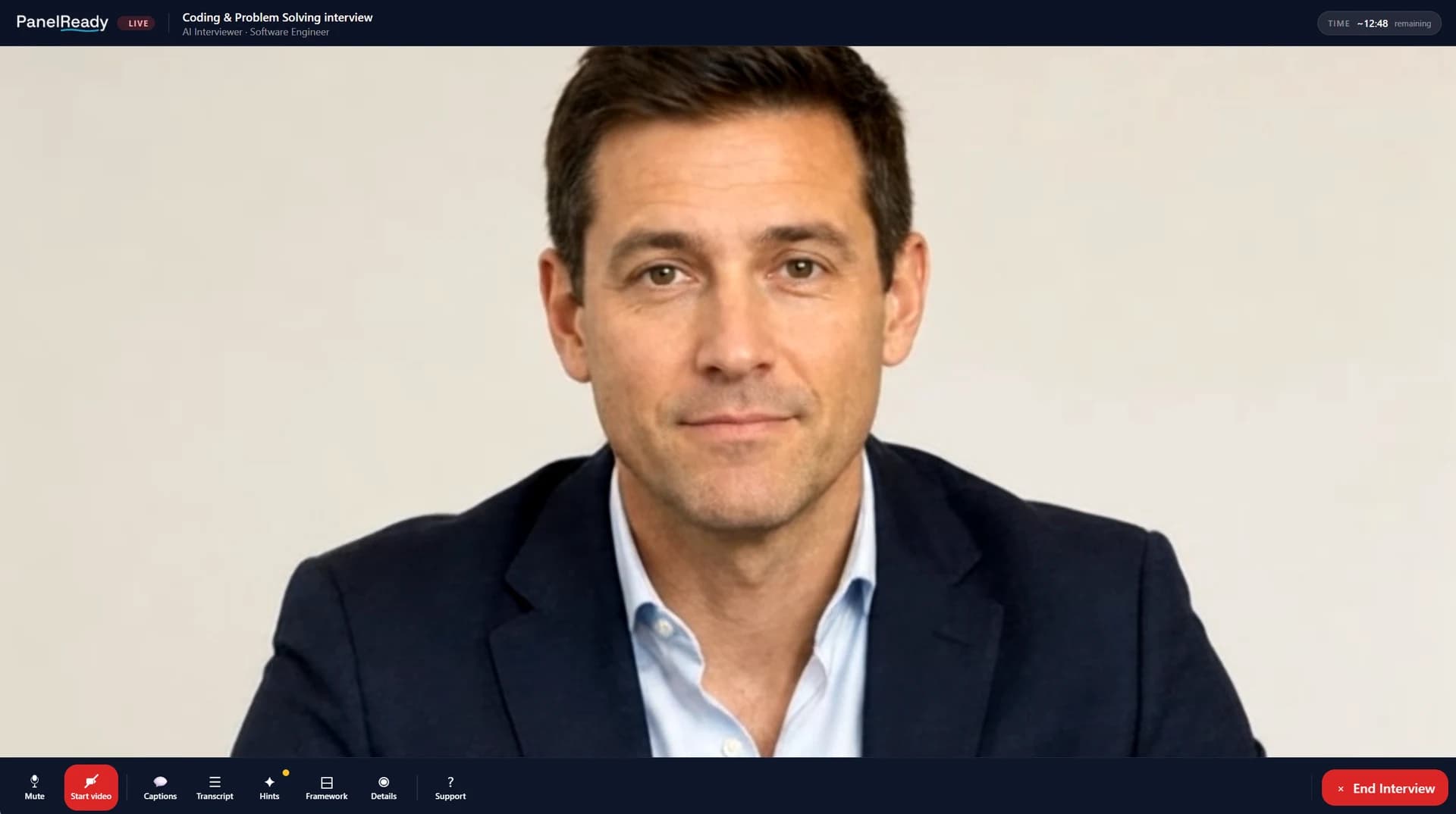
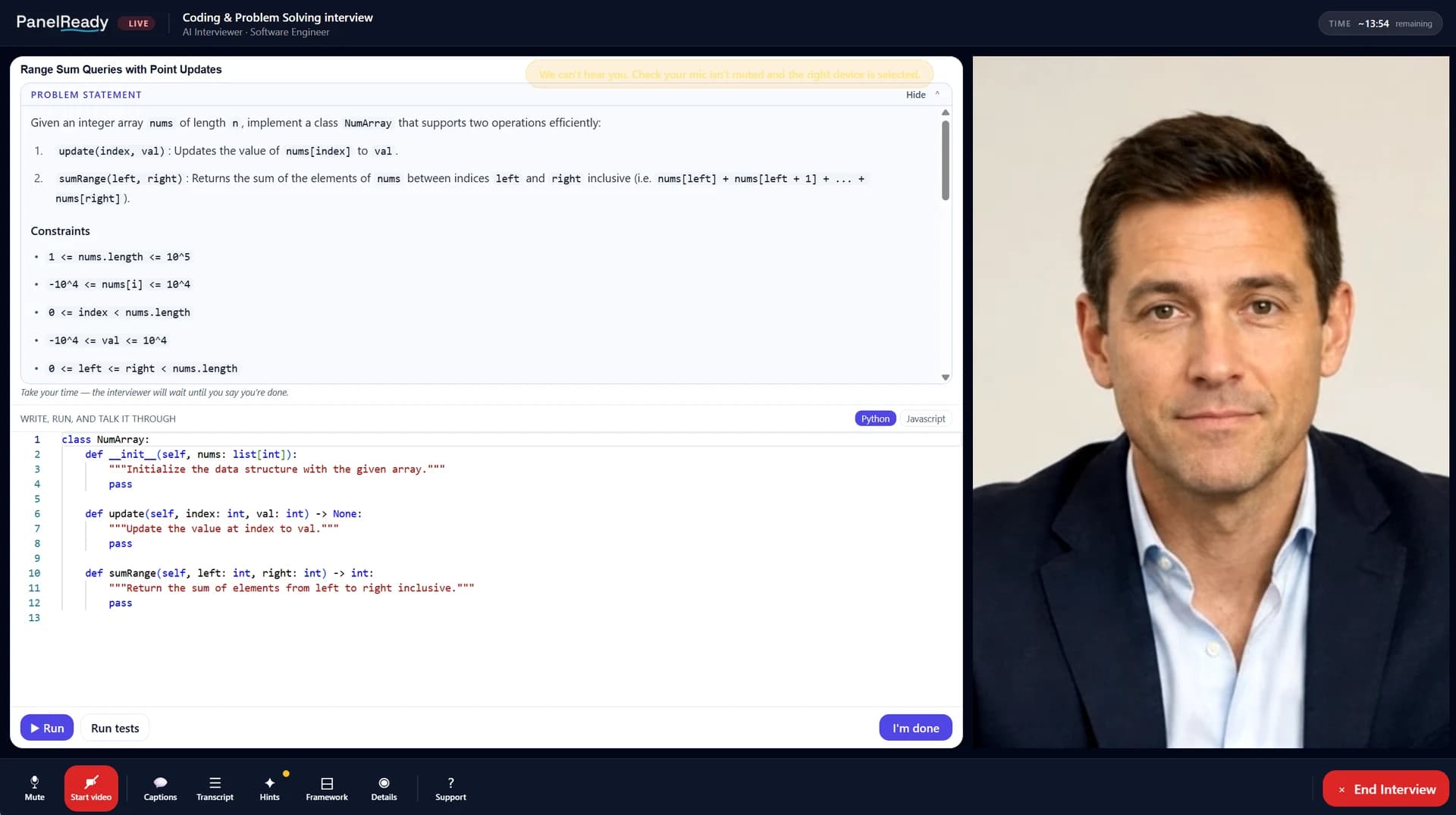
A live interview that follows up on your answers, then shows what they miss for your role and level.
Follow-upBuilt from your last answer
You chose speed over more research. What told you that was the right trade-off?
Pick the company you're targeting and the interview is built around it. Not listed? Type any company and any role in setup, at any level.
and any company you name.
Company names and logos belong to their owners. They show where candidates prepare to interview, not customers or endorsements.
The hard part is answering when someone pushes deeper, and knowing whether that answer would clear the bar for your level.
Whatever you say, the list moves on. Nothing pushes back, and nothing tells you whether the answer would have held up.
The interview adapts to you, and the next session starts where this one found the gap.
Four moves, repeated until the answer holds up under a follow-up.

Choose from 12 roles and 8 target levels, or paste the job description for the interview you actually have.
A live AI interviewer asks, listens and follows up on what you just said. Voice, chat, recorded or video.
Each skill gets a state for your level, tied to something you said, with the fix named.
Run it again on the weak spot. Readiness is built in laps, not in one attempt.
Start from one of 12 premium roles, or name any other role at any company. Then pick a level to see what the interviewer asks and what the bar expects.
Premium12 roles with question banks and rubrics for every level
Sample opening question, Product Management
“How would you improve Spotify for podcasts?”
What the follow-ups probe
The steps you skip: user segments, prioritization logic, and the metric you'd watch.
Judged on skills like
Recognizes frameworks: CIRCLES, AARRR, HEART
What the bar expects at Senior
Trade-offs, influence, and measurable impact: how your call moved other teams and what changed.
Four of the eight levels per role, from entry to executive.
Practice the format your interview actually uses, with the same follow-ups and feedback in each.
Every skill ties back to something you actually said, so the report reads like a to-do list for your next run.
It guides practice. It is not a prediction of any employer's decision.
See a full sample reportClear logic for the trade-off; the strongest part of the answer.
Situation and action are ordered; the result is where it thins out.
Concise and confident; minimal hedging.
The decision's consequence is asserted, never measured.
The same story, told two ways
Weak
“We increased engagement.”
Team credit, no decision, no number.
Stronger
“My decision to simplify onboarding lifted week-one completion from X to Y.”
Your call and a measurable change. Fill in your own X and Y.
Practice for a specific posting, rehearse out loud, and watch the weak spots change.

Paste the job description you're applying for. The interview is built around that role, that company and that posting.
AI-generated editorial illustration
Rehearse the spoken version with an interviewer who reacts to what you say, not a list that moves on.
Every session is judged on the same skills, so you can see whether the work is working.
Illustrative. Your report tracks your own sessions.
Warm up with a friendly one, then face the one who pushes back.
Consent comes before any recording, and audio auto-deletes 30 days after upload. Export or delete your transcripts and feedback any time.
None of these are wrong, and most candidates should use several. The question is which one rehearses the part you'll actually be judged on.
| What the practice gives you | Reading question lists | Watching interview videos | Practicing with generic AI chat | Human mock interview | PanelReady |
|---|---|---|---|---|---|
| Speak your answers out loud | No | No | Partial | Yes | Yes |
| Follow-ups based on what you said | No | No | Partial | Yes | Yes |
| Repeat whenever you want | Yes | Yes | Yes | No | Yes |
| Role-specific context | Partial | Partial | Partial | Yes | Yes |
| Evaluated against a target level | No | No | No | Partial | Yes |
| Actionable feedback afterwards | No | No | Partial | Yes | Yes |
| No scheduling required | Yes | Yes | Yes | No | Yes |
A good human mock interview gives excellent, nuanced feedback. It just costs another person's time and a calendar slot. Many candidates pair PanelReady reps with occasional human mocks.
Generic AI chat can quiz you endlessly, but it typically works in text, follows up inconsistently, and doesn't hold your answer against a defined bar for a role and level.
Pricing
Transparent to a fault. Caps shown up front, one-click cancel, unused interviews roll over within the billing period, and a documented refund policy. No auto-renewal traps.
A free mock interview on any role, no credit card. Genuinely useful, not a trial in disguise.
or $169 / year
For candidates interviewing now. Monthly or yearly, cancel in one click. Billed in your local currency at checkout.
For bootcamps, MBA career centers, employers, and institutions, from a single cohort to a multi-program rollout. Priced to your program.
Out of monthly interviews? Buy a one-time pack of voice or video credits. They never expire and are used automatically once your plan allowance runs out.
Prices shown in USD. In India, prices are shown and billed in Indian rupees.
Running a bootcamp, career center, or placement program? See PanelReady for organizations (cohort dashboards, org rubrics, SSO) or talk to us about a rollout.
How long interview prep takes, what frameworks we cover, how our scoring compares to Final Round AI, Exponent, and Yoodli, and what programs get.
Most candidates spend 6 to 10 weeks at 1 to 2 hours per day, covering the competencies their role is actually scored on, from fundamentals through strategy. The single biggest accelerator is a live, adaptive mock where an interviewer asks real follow-ups, because the spoken format is the one that actually decides the room. PanelReady runs calibrated mocks across 12 roles, from Business Analyst to Software Engineering, plus a Custom track. The free tier lets you run a scored preview before you commit.
Early-career and switcher candidates: 8 to 10 weeks. Mid-level: 4 to 8 weeks. Senior and above: 3 to 6 weeks to polish. Daily 1 to 2 hour practice beats marathon weekend cramming. Run a calibrated mock in week one so you know where you stand against your target level.
They are when the model is grounded in calibrated rubrics, not vibes. PanelReady scores against behaviorally anchored rubrics for your role and level, from junior to executive, shows you the reasoning per dimension, and ties every score back to a specific line you said in the transcript. Score variance across runs is what we calibrated against, not what we ignore.
Not entirely, but for most of your practice it's better: available 24/7, far cheaper than $200 an hour, and consistent across sessions. Save human coaches for the last mile: narrative shaping, executive presence, your specific career story. Use PanelReady for the volume reps every candidate needs.
Yes. The interviewer recognizes when you're working through a framework, probes the steps you skip, and grades the depth of your reasoning. Product management is one example: CIRCLES for product sense, STAR for behavioral, AARRR and HEART for metrics. Other roles have their own, from SQL and experiment design to system design and case structure, and each rubric is anchored to what that role is scored on.
Twelve roles, including Business Analyst, Data Analyst, Data Engineering, Data Science, ML/AI Engineer, Marketing Specialist, Product Management, Product Sales, Program Manager, Sales Specialist, Software Engineering, and UX Design, plus a Custom track. Every interview is calibrated to your role's ladder, from junior to executive, and each level has its own behaviorally anchored rubric (Poor, Borderline, Solid, Outstanding) across the dimensions that role is scored on. "Solid" is the bar: scoring Solid across the board means you're at the level.
The role-and-level rubrics calibrate to any FAANG-style panel (Google, Meta, Amazon, Apple, Microsoft, Uber, Airbnb) and AI-native panels (OpenAI, Anthropic, Perplexity). You can also tailor the interview to a specific company at setup, or paste a job description in the Custom track, which biases questions toward their products and interview style.
Final Round AI runs a real-time copilot inside your live interview. That's a category we deliberately don't enter, because it puts your reputation and the integrity of hiring at risk. Exponent is a content library with peer mocks; PanelReady is the live, scored AI interview that pairs well with their content. Yoodli scores delivery, like filler words and pacing; we score substance, what you actually said.
Yes, and no. One live mock interview per month, a few scored practice drills, and one Custom interview, on any role. No credit card. Enough to feel a full mock and see the scored report before you decide to upgrade.
$20/month or $169/year (about 30% off the monthly rate). Includes 8 live adaptive interviews per month across every role, level, and format, unlimited scored practice, and progress tracking. One-click cancel in your account; unused interviews roll over within the period. Local pricing in India and other eligible markets.
Audio, transcripts, and scores stay on your account; export or delete any time. We capture consent before recording, and all audio auto-purges 30 days after upload. Sign in via Google, Apple, or magic link. SSO and audit logs are part of the Teams plan.
Yes: the Teams plan. It gives programs unlimited mocks per seat, org-specific roles and rubrics, branding, SSO, audit logs, and readiness analytics your team can report on, and scales from a single cohort to a multi-program rollout across districts, university systems, and enterprise L&D. It's priced to your program, so contact us.
Practice out loud, see what needs work, and try again. Start free, no credit card, cancel anytime.
Photo: AI-generated editorial illustration