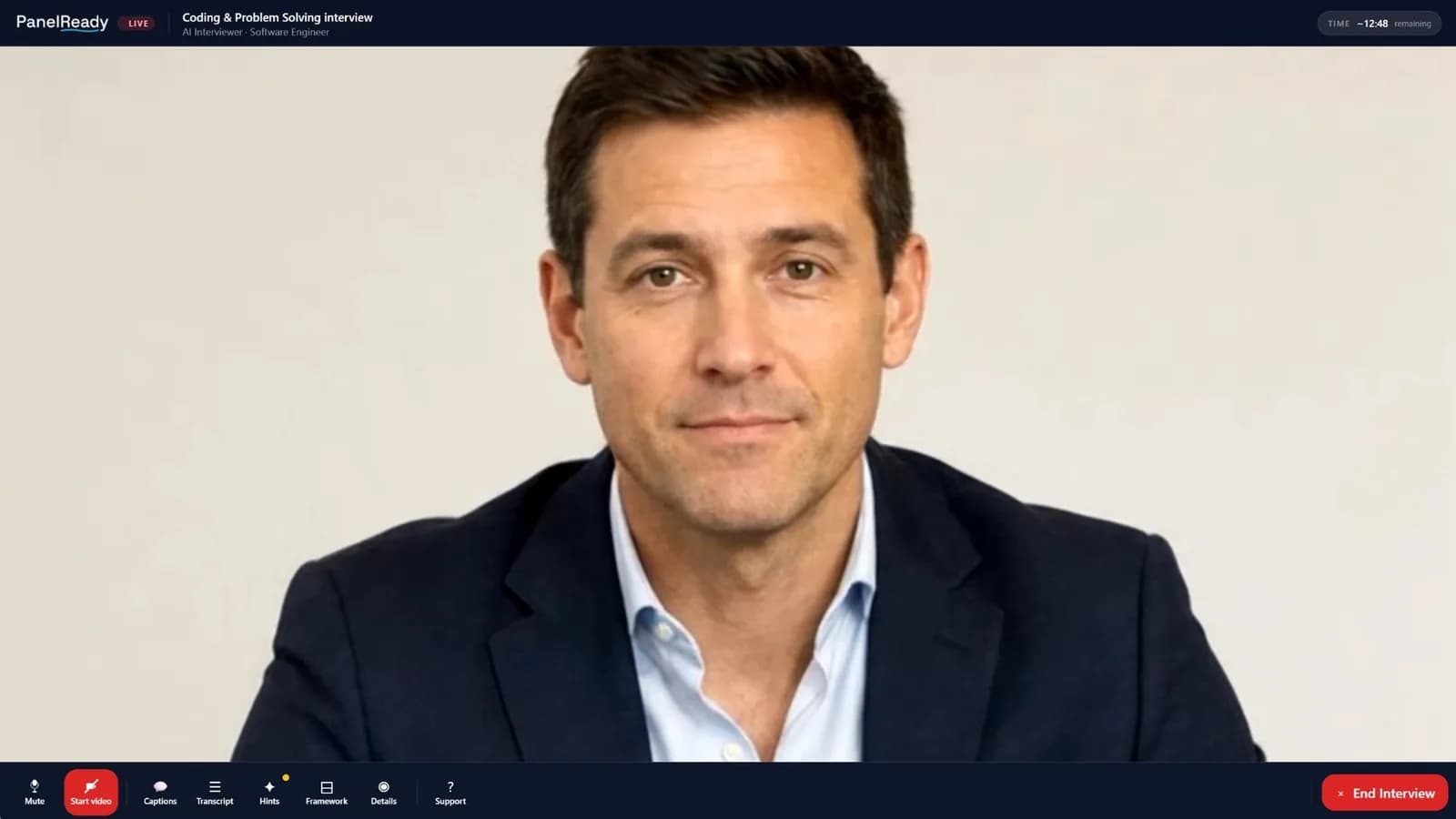
A live spoken or video interview for your role and level. It asks the next question from what you said, then tells you in words what the answer was missing.
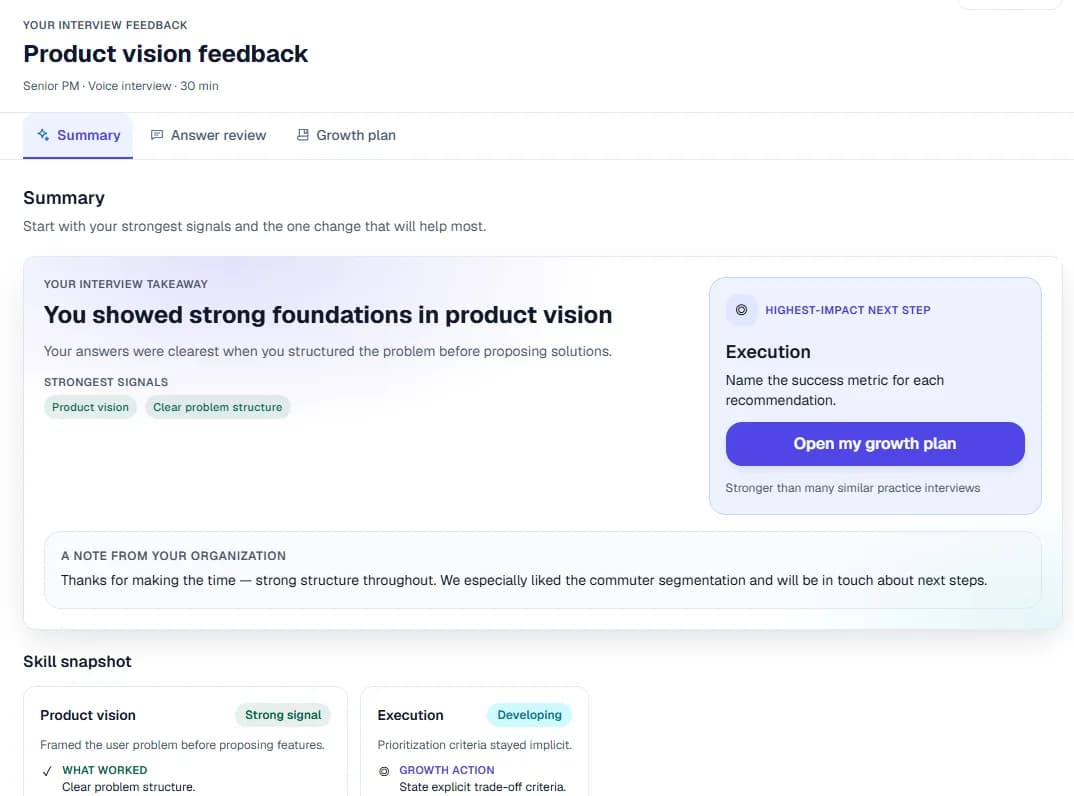
Decision reasoning: Strong signalEach skill in the words you read on your report, never a number.
Follow-up, built from your last answerYou chose speed over more research. What told you that was the right trade-off?
Written to you, in wordsThe takeaway, your strongest signals and one change. No raw scores.
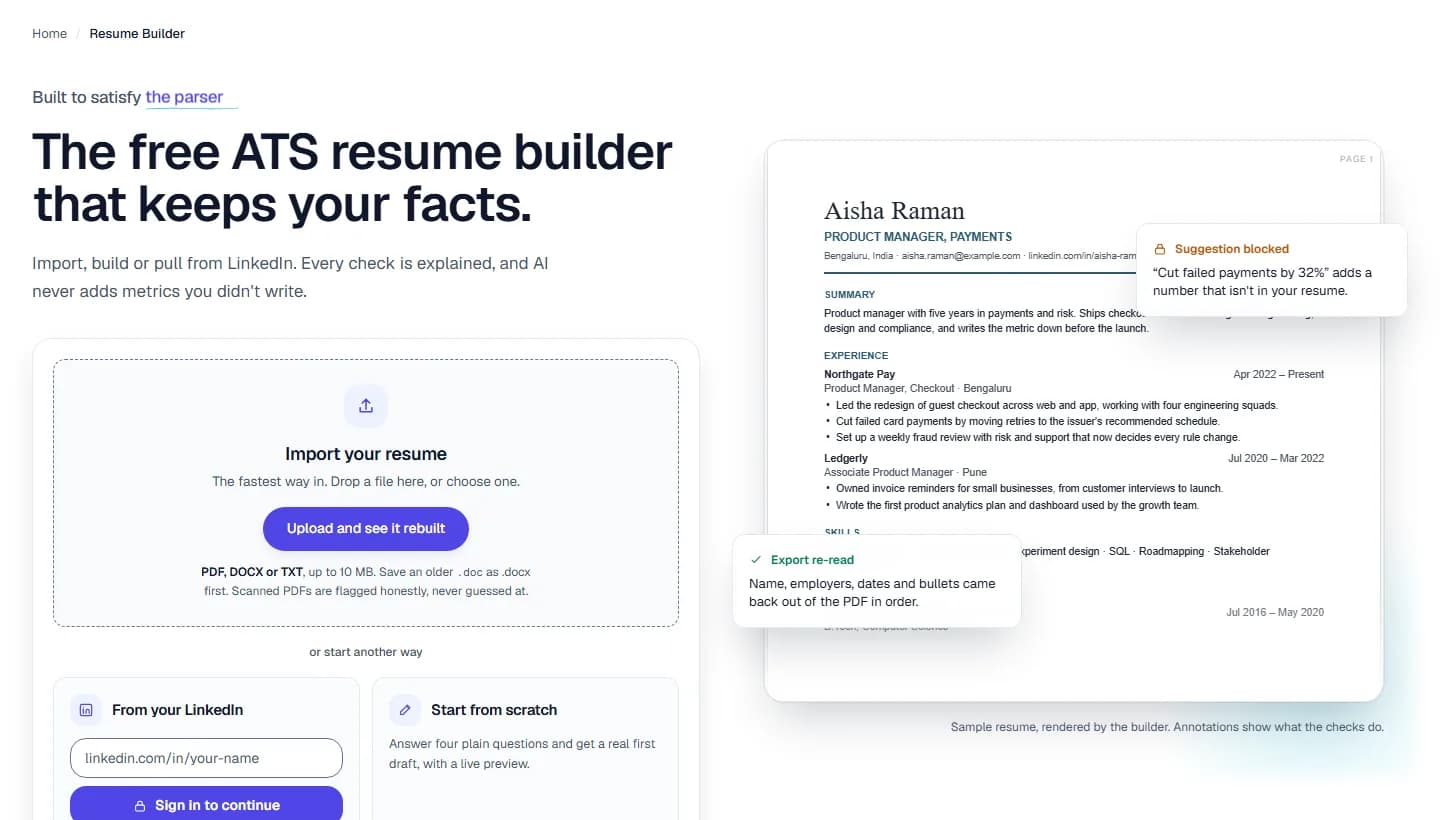
It never adds a number you did not writeA suggestion that invents a metric is blocked and says why.
Actual product screens. The notes show a sample session.
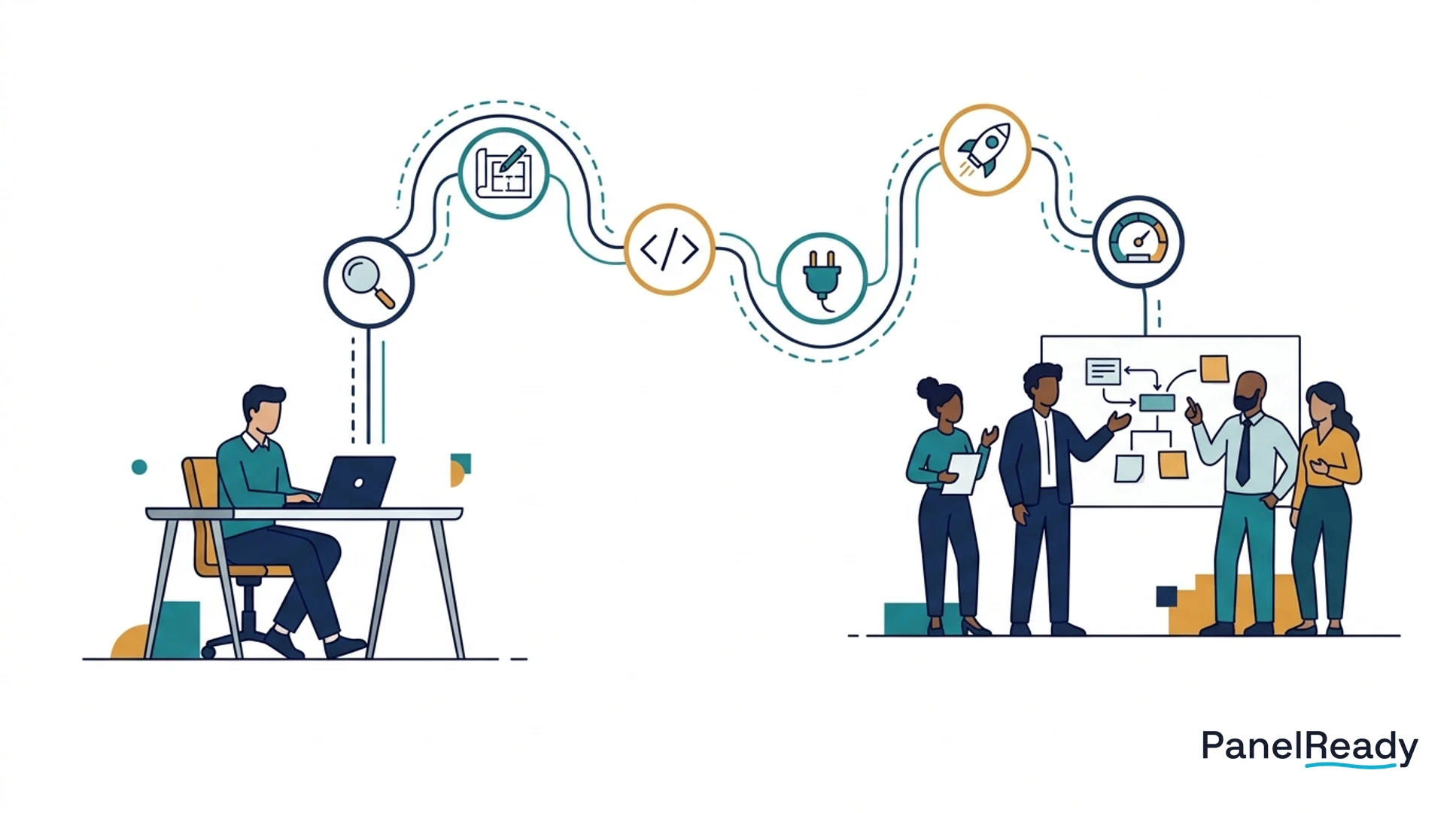
One account, five stops. Asha, aiming at Senior PM, an example candidate.
1
Pick the interview
Your role and level, or the job description you are chasing.
You
2
Practise, out loud
A spoken or video interview that asks the next question.
You
3
Read what it found
Each skill in words, with the line that earned it.
PanelReady
4
Try the answer again
A second attempt, scored to the same bar.
You
5
Tailor and apply
A resume per opening, and the openings posted here.
You
One answer, three questions deep.
A question bank stops at the first question. The interviewer here asks the next one from what you just said, the way a panel does.
Written sample exchange, Product Manager, senior level.
AI
Interviewer: Tell me about a product decision you made with incomplete information.
You
You: We shipped the onboarding change after two days of research instead of the usual two weeks. The drop-off was costing us more every day we waited.
AI
Follow-up, built from your last answer
Interviewer: You chose speed over more research. What told you that was the right trade-off?
You
You: The drop-off sat at the same step for three cohorts, so the problem was clear even if the fix was a guess. We shipped behind a flag and watched that step.
AI
Follow-up, built from your last answer
Interviewer: Behind a flag, watching one step. What would have made you roll it back?
Learn what the interview tests. Then practise it out loud.
Courses by role, written for interviews. Each course page shows its lessons and which of them are free.
Lessons, then quizzes
Read a lesson, then check what stayed with a short quiz.
Exercises reviewed in words
Write code, draw a design or draft an answer. The review says what worked and what to fix, with no score.
Mock interviews on the course
Take a live interview on the questions the course covers, with the interviewer that follows up.
Follow a practice week, from the first question to the application.
Each step is a real screen with example data. Pick a step and open the numbered points.
Pick the interview you are actually facing
You do this
You
Choose a role and level, or paste the job description and name the company. Add your resume so the questions fit your background.
PanelReady
Builds the interview for that level: the questions, the follow-ups it may ask, and the bar it will hold you to.
You get
A rehearsal for the interview in front of you, not a generic question bank.
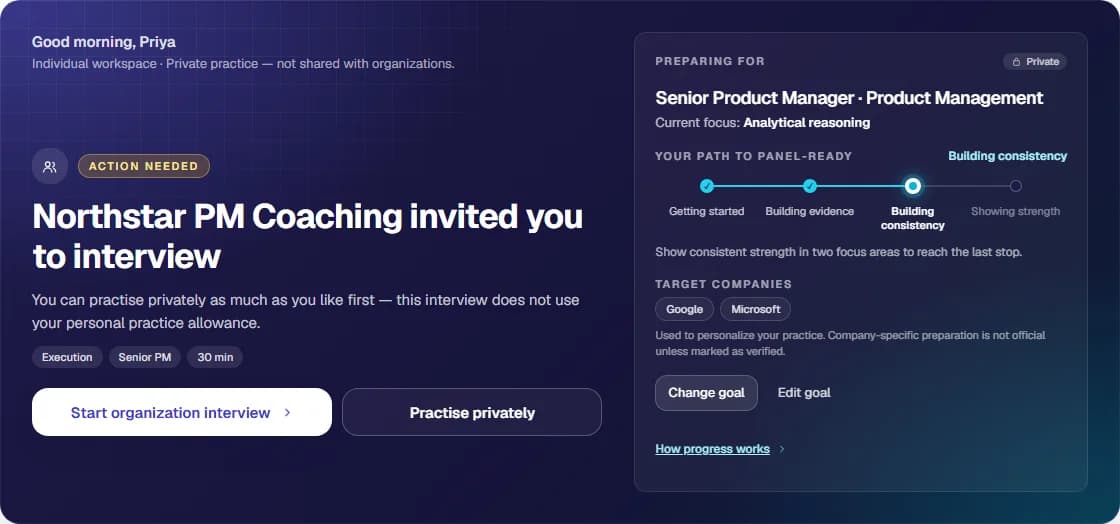
The interview, namedThe role, the level and how long it takes. From your own choice, or assigned by a program or employer that invited you.
One click to startNothing to install. A spoken or video interview in the browser, whenever suits you.
Private practice stays privateWhat you practise on your own is yours alone. An employer sees only the interviews it invited you to.
Your HomeActual product screen, example data
An interviewer that asks the next question from what you said
You do this
You
Talk, the way you would in the room. Voice or video, with captions if you want them.
PanelReady
Listens, and when an answer is thin asks the second and third question, held to the bar for your level.
You get
The feeling of a real panel, before the real panel.
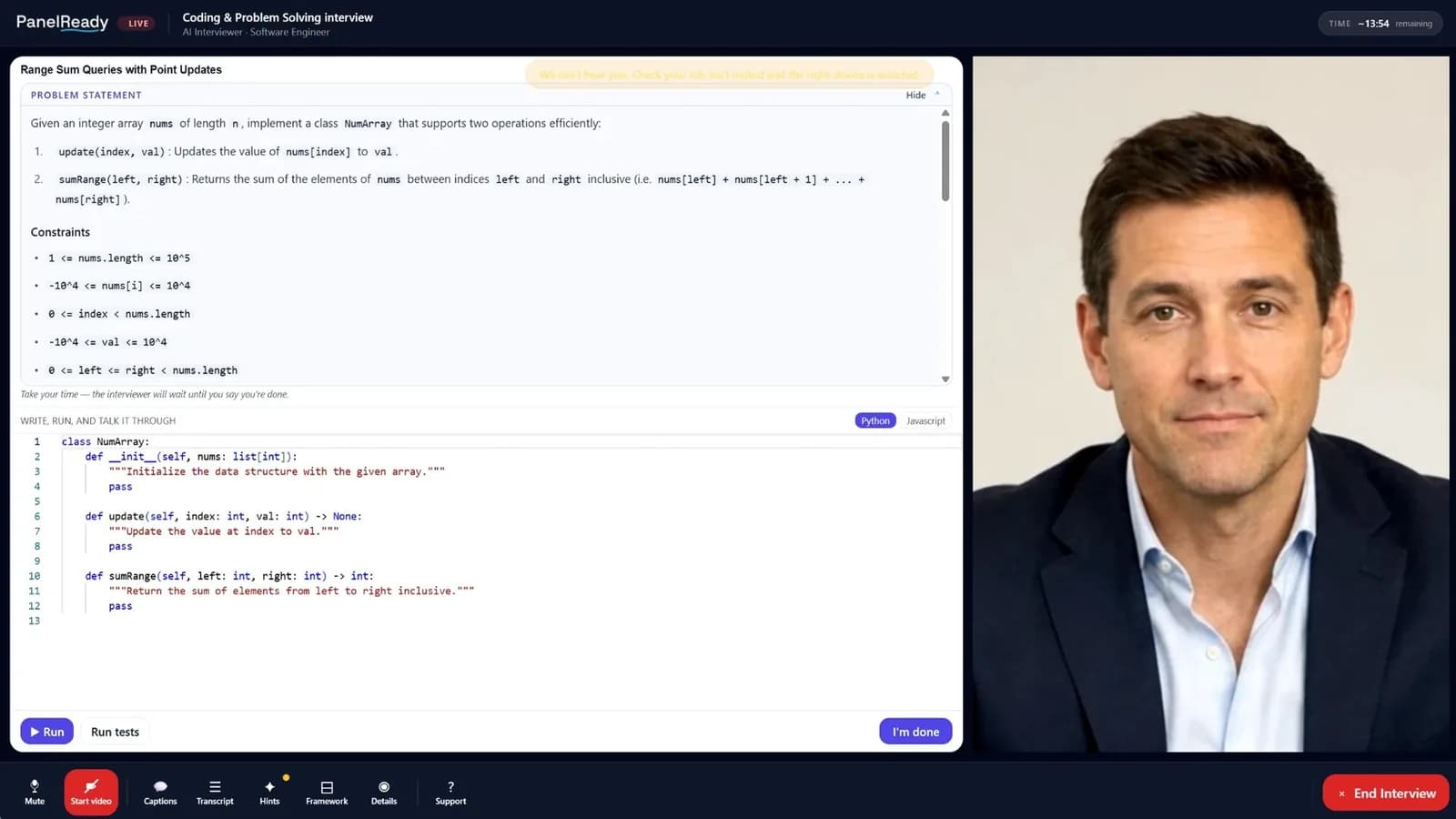
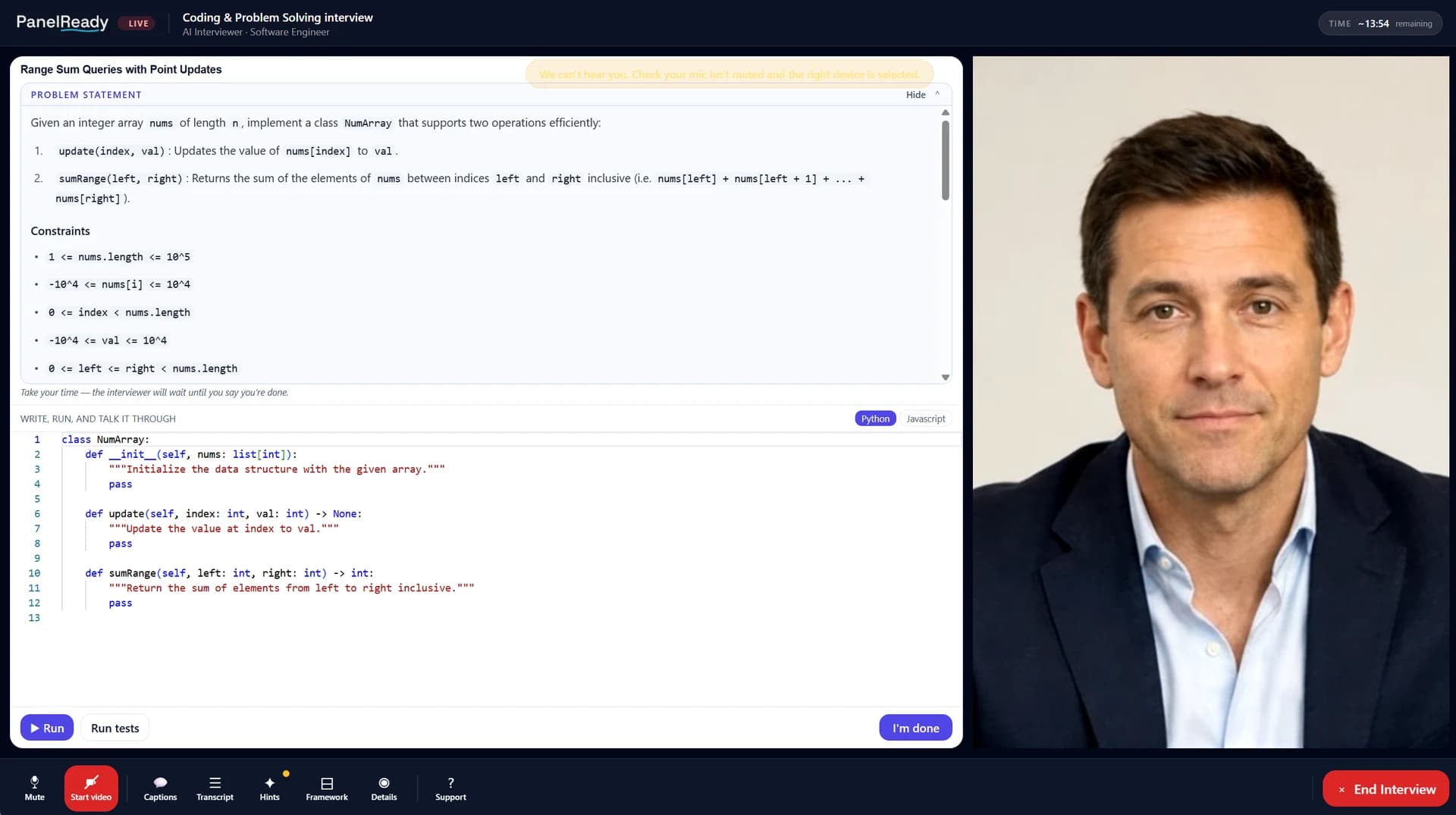
An interviewer that listensVoice or video. When an answer is thin, it asks the second and third question.
Captions and transcript, liveEvery word is in the transcript you read afterwards.
Your time, visibleThe clock is on the screen, as it would be in a real first round.
Code while you talkEngineering tracks open an editor in the room. The interviewer asks about the reasoning, not just the result.
Whiteboard and screen share tooDesign and system questions can be drawn or shown; the room follows the question.
The interview room, spoken and codingActual product screen, example data
Read each skill in words, with the line that earned it
PanelReady does this
You
Read it that evening. Open the skill you expected to be strong and the one you did not.
PanelReady
Scores each answer against written bands for your level and quotes the line behind each one. Then writes the one change to make next.
You get
Words you can act on, never a number to worry about, and a plan for the next attempt.
Written to you, in wordsThe takeaway, your strongest signals and one change. No raw scores anywhere on the candidate side.
The next step you can act onA growth plan built from this interview, ready for the second attempt.
A note from whoever assigned itIf a coach or a program invited you, their note travels with the feedback.
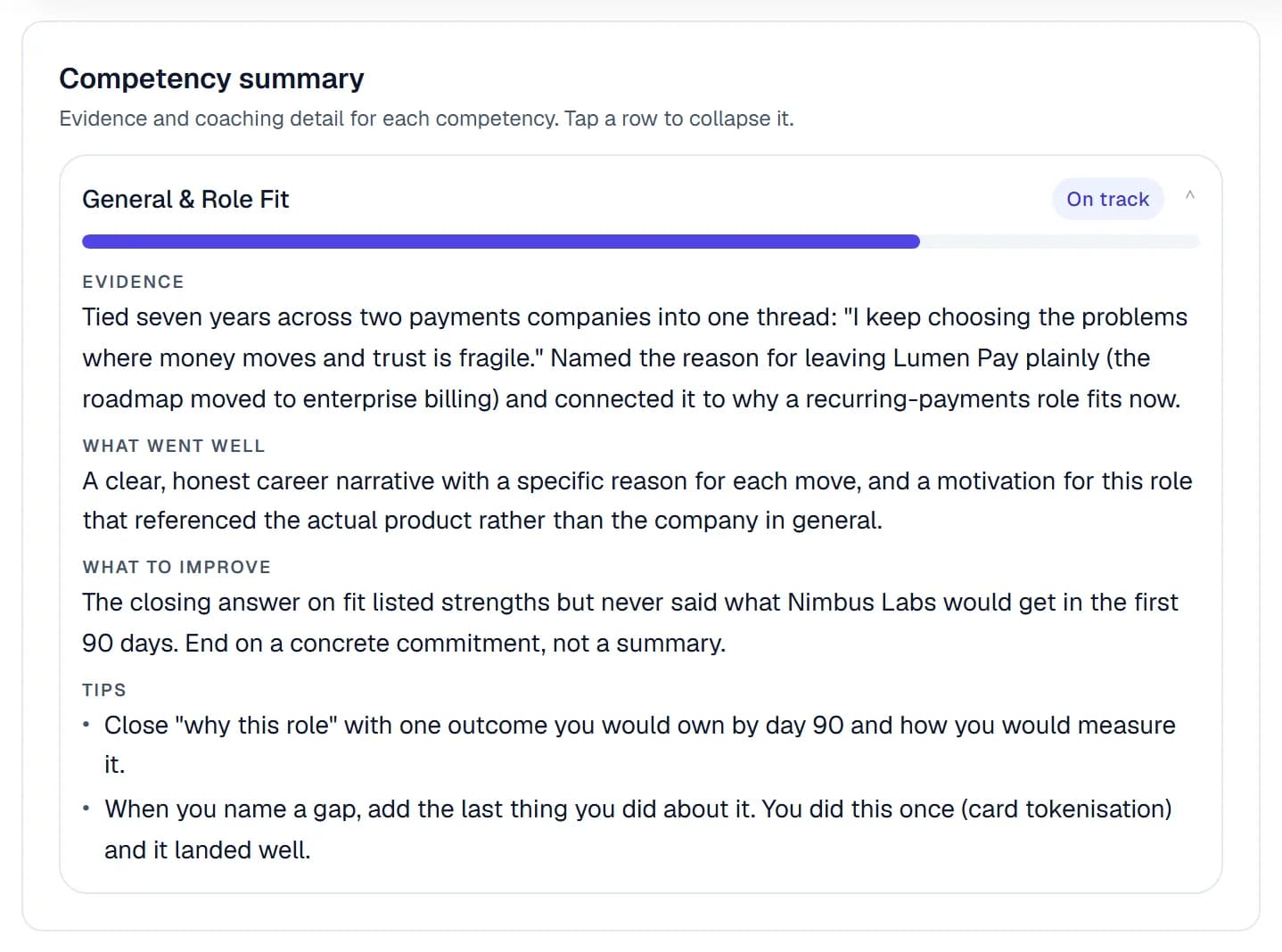
Evidence, quotedThe band is backed by what you actually said, so you can see exactly where it slipped.
What to improve, in one lineThe closing answer listed strengths but never said what the company would get in the first months.
Tips you can use tonightShort and specific. Try the answer again with them.
Your feedbackActual product screen, example data
A resume that passes the screen, tailored to each opening
You do this
You
Import the resume you have, or build one. Paste the job description you are applying to.
PanelReady
Checks it the way the parsers employers use read it, explains every check, and tailors a version to that description without inventing a number or a claim.
You get
A resume the screen can read, in the words the opening uses, still entirely yours.
Start from what you haveDrop a PDF or a Word file, pull from LinkedIn, or answer four questions for a first draft.
It never adds a number you did not writeA suggestion that invents a metric is blocked and says why.
Checked the way a parser reads itName, employers, dates and bullets are read back out of the export, in order.
The Resume BuilderActual product screen, example data
Apply to the teams that hire here, and keep learning in between
You do this
You
Search the openings posted by the companies and placement agencies that hire through PanelReady, and apply with the resume you tailored.
PanelReady
Runs every step after that from the same place: the first screen, the interview, the follow-ups, with your consent asked before anything is recorded.
You get
One account from practice to application, and courses by role and skill when you want to go deeper.
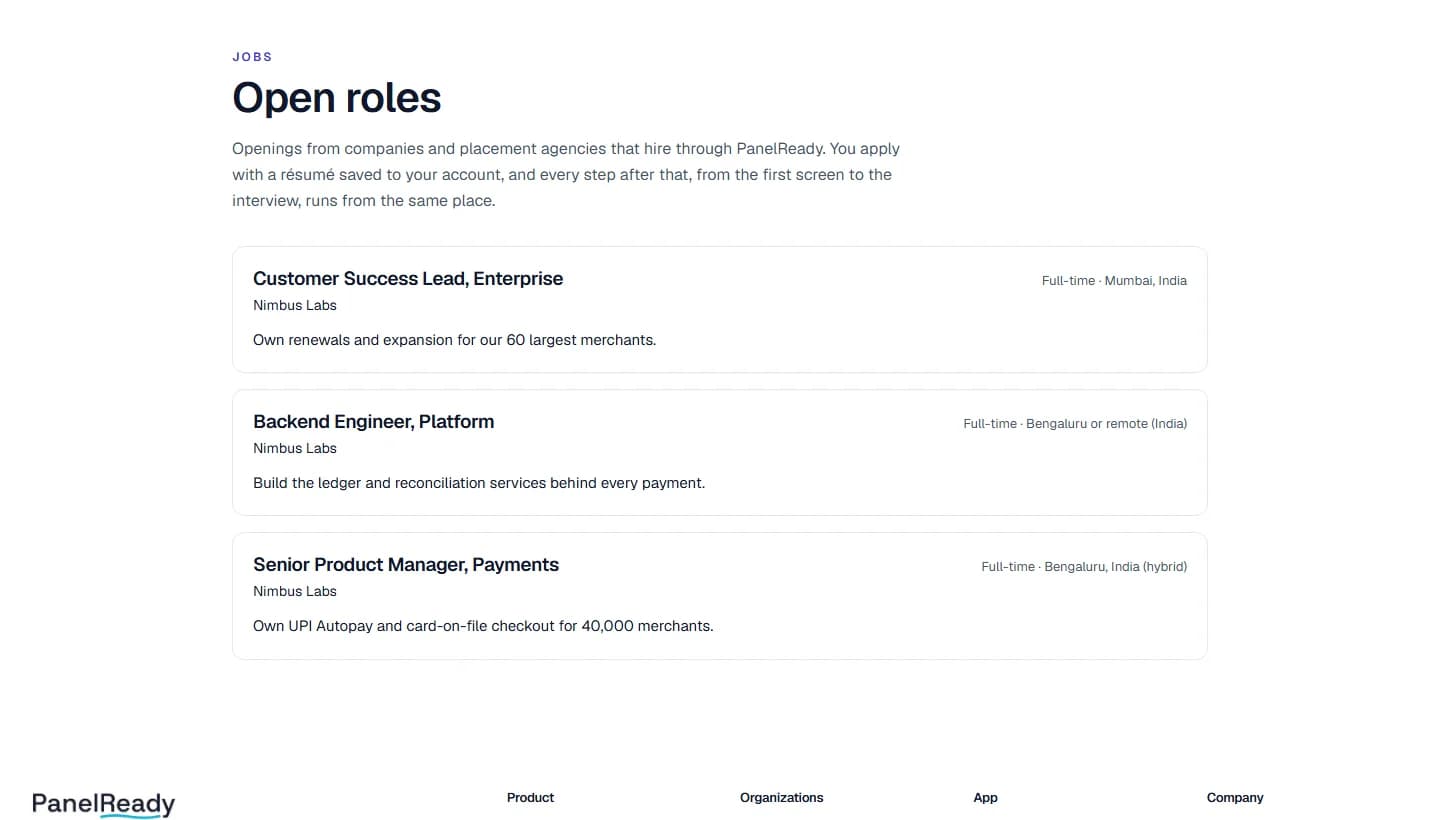
Openings from teams that hire hereCompanies and placement agencies that run their first rounds on PanelReady post here.
Apply with the resume you tailoredThe application uses a resume saved to your account, so the screen reads what you prepared.
The interview runs from the same placeEverything after the application, from the first screen to the interview, happens in your account.
The job boardActual product screen, example data
Four things you can do here, all from one account.
The interview changes with the role. So does the bar.
Start from one of 12 premium roles, or name any other role at any company. Then pick a level to see what the interviewer asks and what the bar expects.
Premium12 roles with question banks and rubrics for every level
Sample opening question, Product Management
“How would you improve Spotify for podcasts?”
What the follow-ups probe
The steps you skip: user segments, prioritization logic, and the metric you'd watch.
Out of monthly interviews? Buy a one-time pack of voice or video credits. They never expire and are used automatically once your plan allowance runs out.
voiceVoice Topup10 credits, $10
videoVideo Topup10 credits, $50
Prices shown in USD. In India, prices are shown and billed in Indian rupees.
Running a bootcamp, career center, or placement program? See PanelReady for organizations (cohort dashboards, org rubrics, SSO) or talk to us about a rollout.
Interview practice, answers without hedging.
How long interview prep takes, what frameworks we cover, how our scoring compares to Final Round AI, Exponent, and Yoodli, and what programs get.
How do I prepare for a role-specific interview?
Work through the competencies your role is actually scored on, from fundamentals through strategy, a little every day. The single biggest accelerator is a live, adaptive mock where an interviewer asks real follow-ups, because the spoken format is the one that actually decides the room. PanelReady runs calibrated mocks across 12 roles, from Business Analyst to Software Engineering, plus a Custom track. The free tier lets you run a scored preview before you commit.
How long does interview prep take?
As a planning guide, we suggest 8 to 10 weeks for early-career candidates and career switchers, 4 to 8 weeks at mid-level, and 3 to 6 weeks to polish at senior level and above. Plan on an hour or two a day rather than long weekend sessions. Run a calibrated mock in week one so you know where you stand against your target level.
Are AI mock interviews accurate?
They are when the model is grounded in calibrated rubrics, not vibes. PanelReady judges each answer against behaviorally anchored rubrics for your role and level, from junior to executive, then shows where you stand on each skill, the evidence from what you said, and what to practice next. It guides practice. It is not a prediction of any employer's decision.
Can an AI mock interview replace a human coach?
Not entirely, but for most of your practice it's better: available 24/7, far cheaper than hourly coaching, and consistent across sessions. Save human coaches for the last mile: narrative shaping, executive presence, your specific career story. Use PanelReady for the volume reps every candidate needs.
Does PanelReady recognize the frameworks I use?
Yes. The interviewer recognizes when you're working through a framework, probes the steps you skip, and grades the depth of your reasoning. Product management is one example: CIRCLES for product sense, STAR for behavioral, AARRR and HEART for metrics. Other roles have their own, from SQL and experiment design to system design and case structure, and each rubric is anchored to what that role is scored on.
What roles, levels, and rubrics does PanelReady cover?
Twelve roles, including Business Analyst, Data Analyst, Data Engineering, Data Science, ML/AI Engineer, Marketing Specialist, Product Management, Product Sales, Program Manager, Sales Specialist, Software Engineering, and UX Design, plus a Custom track. Each of the twelve is calibrated to its own ladder, from junior to executive, and each level has its own behaviorally anchored rubric across the dimensions that role is scored on. Your report on those roles places each dimension in one of four states, from lowest to highest: "Build next", "Developing", "Solid foundation" and "Strong signal". "Solid foundation" means you met what the rubric expects at your level on that dimension, and "Strong signal" means you went beyond it. A Custom interview is built from your job description instead, and its report walks through each question with what worked, what was missing, and a stronger answer.
Does PanelReady have courses as well as mock interviews?
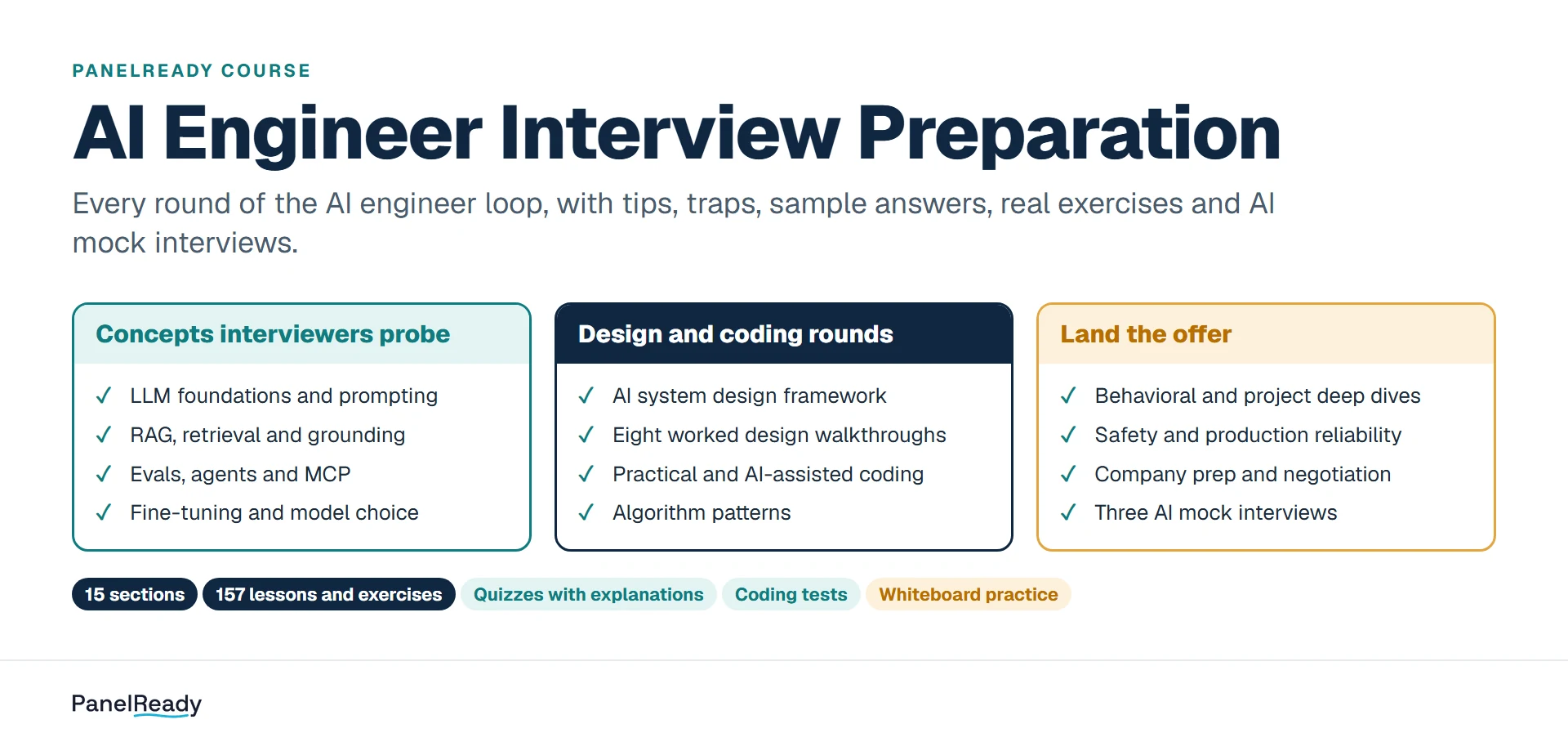
Yes. Courses by role combine lessons and quizzes with coding, whiteboard and written exercises, each reviewed in words. A course also links to mock interviews on the questions it covers, and its page shows which lessons are free.
What companies does this prep me for?
The role-and-level rubrics calibrate to any FAANG-style panel (Google, Meta, Amazon, Apple, Microsoft, Uber, Airbnb) and AI-native panels (OpenAI, Anthropic, Perplexity). You can also tailor the interview to a specific company at setup, or paste a job description in the Custom track, which biases questions toward their products and interview style.
How is this different from Final Round AI, Exponent, or Yoodli?
Final Round AI runs a real-time copilot inside your live interview. That's a category we deliberately don't enter, because it puts your reputation and the integrity of hiring at risk. Exponent is a content library with peer mocks; PanelReady is the live, scored AI interview that pairs well with their content. Yoodli scores delivery, like filler words and pacing; we score substance, what you actually said.
Is the free tier really free? Do you ask for a credit card?
Yes, and no. One live mock interview per month, a few scored practice drills, and one Custom interview, on any role. No credit card. Enough to feel a full mock and see the scored report before you decide to upgrade.
What does Pro cost? Can I cancel easily?
$20/month or $169/year (about 30% off the monthly rate). Includes 8 live adaptive interviews per month across every role, level, and format, unlimited scored practice, and progress tracking. One-click cancel in your account. Local pricing in India and other eligible markets.
What happens to my recordings and data?
Audio, transcripts, and feedback stay on your account; export or delete any time. We capture consent before recording, and recordings are deleted automatically after a set period. Sign in via Google, Apple, or magic link. SSO and audit logs are part of the Teams plan.
Do you offer plans for bootcamps, MBA programs, or employer L&D?
Yes: the Teams plan. It gives programs unlimited written practice for every seat, live interviews per seat set in your quote, org-specific roles and rubrics, branding, SSO, audit logs, and readiness analytics your team can report on, and scales from a single cohort to a multi-program rollout across districts, university systems, and enterprise L&D. It's priced to your program, so contact us.
Make the real interview your second attempt.
Practice out loud, see what needs work, and try again. Start free, no credit card, cancel anytime.